Reviewer Best kind of tip - one sentence to explain, and players will actually remember to do it.
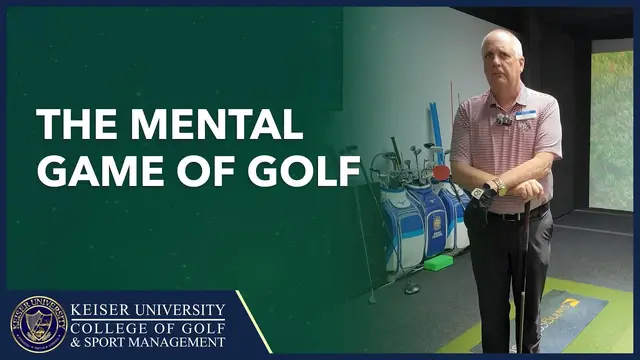
Moderator Whole video is about managing focus and fatigue across a round - exactly the mental-game territory, delivered by a PGA Master Professional.
38 free videos on technique, drills and tips, each tagged by level

Reviewer Best kind of tip - one sentence to explain, and players will actually remember to do it.
Moderator Whole video is about managing focus and fatigue across a round - exactly the mental-game territory, delivered by a PGA Master Professional.

Reviewer Real technique here - flip the fear question into an excitement question, and quit coaching yourself in negatives. This one is worth drilling on the course.
Moderator Squarely about fear and anxiety on the course, one of the named core topics for this sub-skill. The entire video is the FEAR acronym, the basic neurochemistry behind it, and a concrete reframing method. No mechanics content anywhere in it.

Reviewer Great one - the tour stats alone will recalibrate how a mid handicapper judges their own round.
Moderator Entirely about the mental trap of unrealistic expectations and how that spirals into frustration and bad play - this is the mental game's bread and butter.

Reviewer Give every player this before their next round - simple, correct, and it'll actually change their pre-shot talk.
Moderator Dead center on mental game - the entire video is about reframing self-talk from negative ('don't hit it in the water') to positive target-focused language. Nothing else competes for screen time.

Reviewer Clean, demonstrated, and covers the mental basics better than most full courses do.
Moderator Structured top-5 countdown entirely about mental game — visualization, confidence, emotional stability, routine — nothing here is about swing mechanics or anything else.

Reviewer A genuinely useful, easy-to-remember technique you can use on your very next round.
Moderator This is a direct answer to how to actually become more present between shots -- the 75% of the round that isn't the swing -- and gives a specific sensory grounding exercise to use in that time. Squarely mental game, and unusually concrete about it.

Reviewer This is exactly what breaks the yips - get your head off the result and onto what you actually control, then lock onto rhythm. Steal this drill.
Moderator Textbook mental-game content. Takes the yips and correctly frames them as an attentional and internal problem rather than a physical glitch, then lays out the fix in two clear steps. This is exactly the kind of content this sub-skill exists to catalog.

Reviewer Break the round into six mini-rounds — this is one of the better concrete focus tricks I've heard explained on video.
Moderator Whole video is one specific mental-game technique for maintaining focus across 18 holes — nothing else competing for the runtime.

Reviewer Don't become your score — simple point, well made, and it'll save you a lot of self-inflicted misery.
Moderator The entire video is about how a golfer's identity and self-worth relate to their score — textbook mental game territory, not a stray tip bolted onto a swing lesson.

Reviewer Give a guy two rounds with 'visualize, routine, commit' on repeat and you'll see the scores settle down.
Moderator Dead center on the sub-skill — the entire video is a structured breakdown of process golf vs outcome golf, nothing else competing for airtime. This is what 'golf mental game' means.

Reviewer A coach who actually competes handing you a real fix for swing-thoughts creeping onto the course - care less, not careless, is a line worth stealing.
Moderator Entirely about quieting the mind on the course. Draws a clean distinction between mechanical thoughts (swing thoughts creeping in during play) and emotional thoughts (caring too much, trying too hard), and ties both back to the pre-shot routine work from earlier parts of this series. Zero time spent on swing mechanics itself. Dead center of the sub-skill.

Reviewer Best explanation of tournament nerves I've seen on YouTube - just know the practical fixes come later in the video.
Moderator The entire video is about why nerves show up on the course - squarely mental game, and better sourced than most (a stress researcher, tour pros describing their own experience).

Reviewer Genuinely teaches something and backs it with real research - one to send to any golfer who overthinks their swing.
Moderator Squarely about how swing thoughts and decision-making trip golfers up mentally - ties a real psychological framework (paradox of choice) directly to on-course and practice decisions the whole way through.

Reviewer One of the better mental-game rundowns in the queue - specific, well-grounded, easy to actually use.
Moderator This is the mental game skill directly - nine distinct, well-organized techniques (spotlight effect, control-freak trap, staying present, grit, the 'caring game' balance) with no digression into swing mechanics or anything else.

Reviewer The waggle point alone will fix a habit most golfers don't even know they have.
Moderator Builds an actual pre-shot routine step by step - waggle mechanics, standing behind the ball to pick a line, practice swings to find rhythm and feel the ground, limiting swing thoughts on the course to one or two. Squarely the mental-game/pre-shot-routine sub-topic, well developed.

Reviewer The acted-out before/after makes this stick — better than most 'stay positive' videos.
Moderator One idea, fully committed to: accepting bad shots so they don't compound. The dramatized bad-reaction vs good-reaction skits both stay locked on the mental response to a poor shot, then it's backed up with the presenter's own competition footage.

Reviewer Real substance from the best in the business, though you'll need some course-management background to fully use it.
Moderator Tiger talking specifically about how he thinks his way around a course - playing from the green backward, avoiding mental errors, course management as chess. This is the mental game skill from the best possible source.

Reviewer Seve didn't look at the ball either — decent lesson buried under a bad title.
Moderator Explicitly frames short game through a psychology lens — target-focus vs ball-focus, visualization on chips — and explicitly tells viewers to leave technical thoughts on the practice green. This is mental game applied to a specific shot, not a technique lesson wearing a clickbait title.

Reviewer The between-shots point alone is worth more than most 'stay positive' mental game advice.
Moderator Five clean, distinct keys to the mental game - knowing your best state, resilience to circumstance, distilling swing thoughts, accepting variance, and quality of time between shots. Stays on mental game throughout, doesn't wander into technique.

Moderator Three clean, specific mental-game tips -- drop score expectations, build a real pre-shot routine that includes decision-making and trust, and aim at the target instead of the trouble. All three are squarely about the mental approach to a round, nothing about mechanics.
Reviewer Simple, sound advice you can actually apply on your next round.

Reviewer Genuinely useful to hear how a coach talks a player out of overthinking a tee shot.
Moderator Real coaching conversation entirely about visualizing the tee shot, picking a target/miss side, and managing the mental spiral after a bad outcome (overthinking trouble, score creep). This is course management and imagery — squarely mental game.

Reviewer Good primer to sample from, but don't expect depth on any single tip.
Moderator Wall-to-wall mental game tips - technique-free swing thoughts, pre-shot routine, superstition, visualization, affirmations. Every tip covered so far stays on the mental side of the game.

Reviewer Good breadth, actually explains the 'why' behind each tip instead of just naming them.
Moderator Wall-to-wall mental game tips — visualization, present-moment focus, pre-shot routine, self-talk, goal-setting, breathing, process focus, mindfulness, learning from mistakes. Every point ties directly to the mental side, no filler about swing mechanics.

Reviewer Good idea, loosely delivered — worth the watch but you'll have to pay attention to catch the actual method.
Moderator On-course, played-out demonstration of managing emotion after a bad shot — entirely mental game, technique demos are incidental to the point being made.

Reviewer Great mental model buried in a documentary - the quality of your bad shots matters more than your good ones is something every serious player should sit with.
Moderator Entirely a mindset case study: why Tiger rebuilt his swing after a historic win, framed around his mental model of sustainability and managing imperfection under pressure rather than chasing peak form. There's no swing-mechanics instruction here, it's analysis of his psychology and decision-making. Squarely mental-game territory, just in documentary and analysis form rather than direct-address lesson form.

Reviewer Solid advice from someone who's actually stood on a first tee not hitting it well — worth the watch.
Moderator Straight interview about the mental side of tournament golf — accepting variable ball-striking day to day, playing the shot pattern you've got, competing without your A-game. Every minute is on-topic for mental game, nothing about swing mechanics creeping in.

Reviewer Solid breathing tool, just ignore the sales pitch at the end.
Moderator Squarely about golf stress and its effect on the swing - explains a mechanism (tense muscle fibers) and gives a coping tool (3-5 breath). On-topic throughout except the pitch at the very end.

Reviewer Short, to the point, and it's advice you don't hear as often — worth it.
Moderator Entirely about what to do in the dead time between shots — head up, self-talk, mental breaks. A specific, underserved corner of the mental game, no wandering into swing content.

Reviewer Authentic pro insight -- trust your prep, play the day you're having. Short but real.
Moderator A tour pro directly answering a question about maintaining mental focus on a difficult course -- genuinely about the mental game, from a credible source.

Reviewer A good reframe to think about, but light on anything concrete to actually practice.
Moderator This is entirely about the internal state behind a great shot -- breathing, a quiet mind -- and framing that state as something to notice and return to rather than chalk up to luck. It's mental-game content start to finish.

Reviewer Good war stories and honest opinions on gamesmanship, but don't expect a system you can take to the course.
Moderator This is squarely mental-game material -- pre-shot psychological tactics in match play, using the McIlroy/Augusta anecdote and the classic 'do you breathe in or out' distraction to illustrate how golfers try to get an edge over an opponent. It stays on the mental side throughout, never drifts into swing mechanics.

Reviewer Decent nugget - picture a shot you've actually hit before, not just a good shot in the abstract - but it's a soundbite, not a full lesson.
Moderator Short clip, but entirely about visualization ('paint a picture') and positive self-talk, built around the Jordan Spieth and Michael Greller example. No swing mechanics discussed anywhere. On topic throughout, just brief.

Reviewer Good credentials and a good setup, but this clip is all preamble - nothing to actually go practice yet.
Moderator Both speakers stay entirely on the mental side: a PGA pro's personal story of hitting a performance ceiling despite good ball-striking and discovering mindfulness, then a sports-psych-minded oncologist framing why the mental game is the highest-leverage part of improving at golf. No swing mechanics discussed at any point. Squarely on topic, just still in throat-clearing and credibility-building mode since this is billed as the intro.

Reviewer Decent as a pre-round calm-down track and there is a real visualization technique buried in it, but it will not teach you to do this yourself - you just have to keep hitting play.
Moderator This is a guided meditation and visualization track built specifically for golf, not generic wellness content with 'golf' bolted on. Every cue ties back to golf performance: recalling a peak golf shot, visualizing swing rhythm, feeling focused over every shot, picturing the round ahead. It doesn't teach mechanics and doesn't wander off-topic. Squarely mental-game content, just delivered as an experience to follow rather than a lecture.

Reviewer Solid idea, but it's over before it really teaches you how to use it.
Moderator This is a short mental-game reset routine - tap the club, flip a tee, or take a practice swing to mark a clean break from the last shot. That's core mental-game work: managing your head between shots, not swing mechanics. Squarely on topic for the mental side of golf.

Reviewer Interesting bios, but you won't leave this segment knowing anything you can use on the course yet.
Moderator Topic is squarely mental game — fear in golf, mastery vs eagle golfer, pre-shot routine are all named as the agenda. But this chunk is almost entirely bios and setup; the actual teaching is promised for later in the interview, not delivered yet here.

Reviewer A couple of genuinely good insights buried in a loose chat - you have to mine for them.
Moderator Interview format, but it stays on self-belief and mental game the whole way through - no drift into technique or anything else. Squarely on-topic, just delivered as a conversation rather than a lesson.

Reviewer A quick nod to mental-game basics, but too short to really teach the techniques it names.
Moderator This is squarely about the mental side of golf - visualization, breathing work, and positive self-talk to manage negative thoughts on the course. That's exactly the mental game, not swing mechanics or equipment.